
Hotel Owner Conference 2026 series
Margins: what the big groups check every morning
Demand is holding up. Margins are not. Three of the industry’s biggest operators explained how they protect profit day to day — and most of it can be done by an independent with a spreadsheet and a phone call.
The session
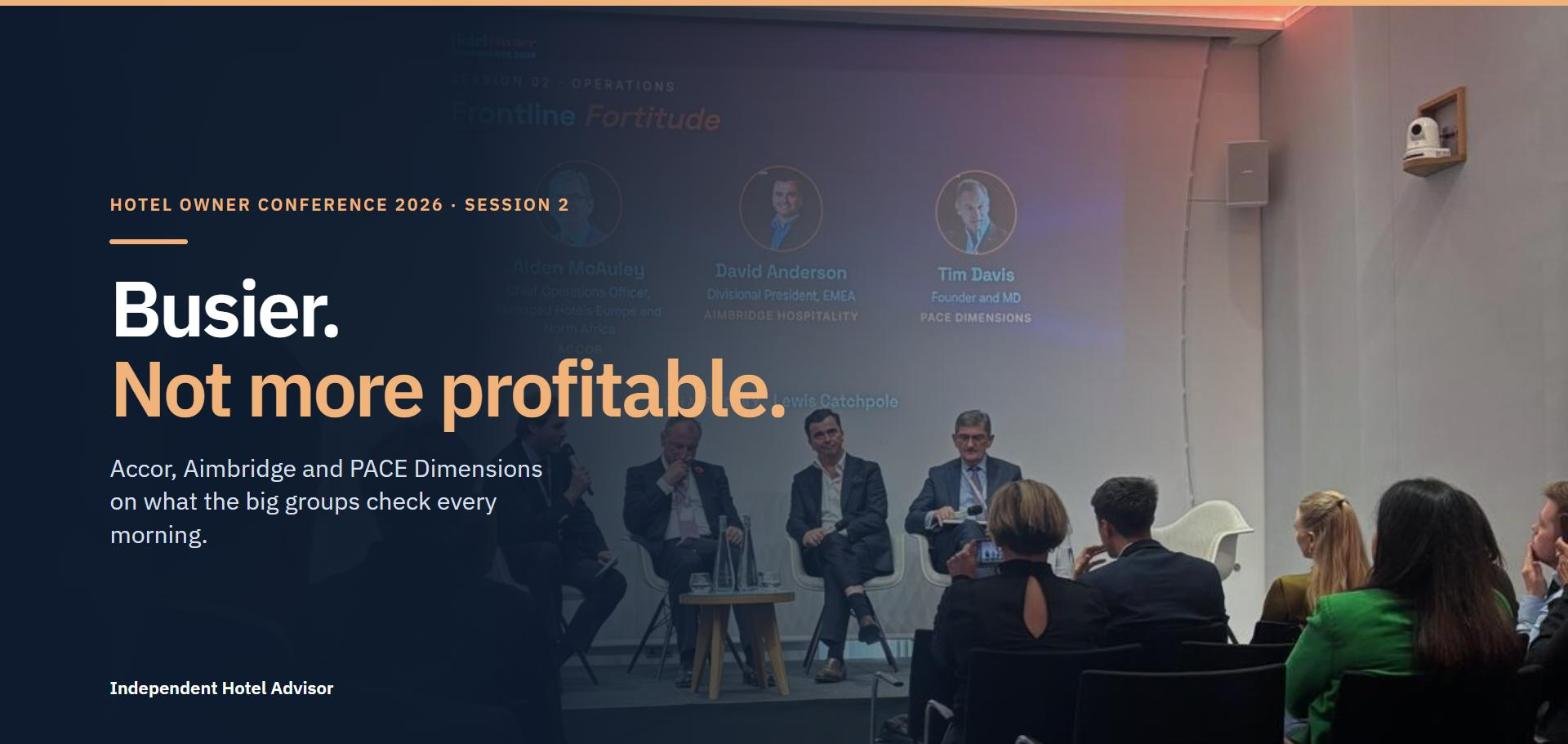
The second session of the day, “Frontline Fortitude”, was about balancing standards with margin pressure. On the panel: Aiden McAuley, Chief Operations Officer, Managed Hotels Europe and North Africa at Accor; David Anderson, Divisional President, EMEA at Aimbridge Hospitality; and Tim Davis, Founder and MD of PACE Dimensions. Lewis Catchpole chaired.
It followed straight on from the Lloyds session and picks up the question part two left open: if costs are rising faster than revenue, where does the margin come from?
Busier, but not more profitable
Rates are up. Margins are down. Standing still now takes real growth.
Tim Davis put numbers on it. Across the UK in the first three quarters of the year, average rate rose by around £4 while margins fell by about a percentage point. Demand is strongest in corporate, then group; leisure is flatter.
David Anderson went further: to simply stand still on the bottom line, a hotel now needs to grow RevPAR by seven or eight per cent. Anything less and costs take the difference.
The 10am report
Don’t wait for month-end to find out what went wrong.
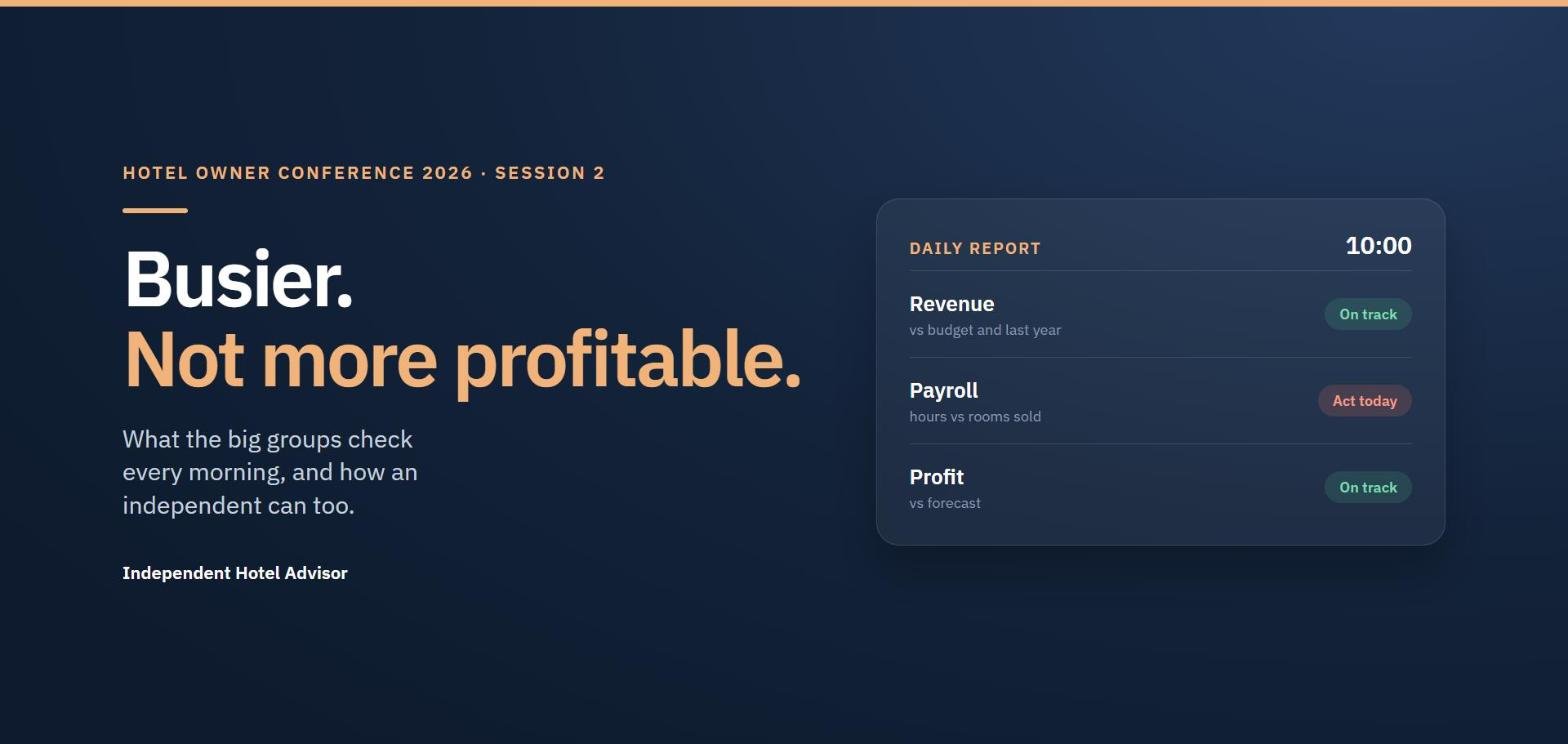
The most practical idea of the session came from Aimbridge. When the National Insurance rise was announced, they built an automated report that lands in every general manager’s inbox at ten every morning. It compares the hotel’s actual performance with forecast, budget and last year, across three areas — revenue per available room, payroll and gross operating profit — and shows each line in red or green.
The general manager sits down with the team and fixes what is red that day. As David put it: “Gone are the days where you look back at your P&L and say, ‘Well, why did we screw up?’”
The results are measurable. Around three-quarters of their hotels now improve their expense lines within the month, and labour as a share of revenue is lower than a year ago. Heads of department get the same kind of view for their own areas.
Payroll and energy first
Ask two questions before anything else: is my payroll right, and is my energy fixed?
Aiden McAuley named the two biggest costs in any hotel: payroll and energy. Accor’s procurement team went directly to energy suppliers and offered owners the chance to fix their prices in advance. Most took it, and it saved millions across their hotels’ accounts.
Aimbridge fixes around three-quarters of its utilities the same way. David said hotels that join them from outside that arrangement are often paying 35 to 40 per cent more for energy. His advice on where any owner should start was simple: is my payroll optimised, and am I hedged on my utilities?
Demand mix, not just rate
You can’t keep putting prices up. You can change who you sell to, through which channel, and when.
Tim Davis argued that the days of simply raising prices are over: with costs and price resistance both rising, the levers are elsewhere. The first is demand mix — the balance of segments, channels and customer types. Even in a flat market, there are pockets of stronger demand for hotels that can shift their mix towards them.
The second is connecting commercial decisions to operational ones. Every hotel has capacity — rooms, tables, meeting space — and a labour cost to serve it. Packages, upselling and filling quieter periods only pay if they are matched to where you have spare capacity and the staff to deliver it.
He suggested keeping a close eye on five things:
- Demand mix
- Capacity
- Productivity
- Investment
- Accountability: who delivers what
And even though booking windows keep shortening, keep a forward view of at least six months. Most of the actions that change demand — redirecting sales effort, building packages — take months to work.
Being found in an AI world
AI decides which hotels people see. It reads your content and your reviews.
All three panellists came back to visibility. Aiden pointed out that AI-driven search now pulls together websites, photos, guest feedback and how you respond to it, and ranks you against your competitors. Keep your website and photos current and reply to every review.
Tim’s advice was not to chase AI tools of your own — very few individual hotel companies get a return from building AI. The value is coming from the big technology platforms. What matters is the accuracy and detail of your own content: rooms, prices, availability, photos and descriptions. David added that hotels with recurring complaints about their condition risk being left out of AI search results altogether.
Invest in stages
Crawl, walk, run — and don’t cancel a project halfway.
Tim warned against big projects that only pay back at the end. Break any investment into stages — now, next, later — with a commercial result at each one, and review the whole list regularly. Cancelling a half-finished project when money gets tight wastes everything already spent.
What an independent hotel can do
An independent doesn’t have a procurement team of hundreds or a business intelligence department. But nearly everything in this session scales down.
- Build your own morning report. Three lines, every day: revenue, payroll hours and an estimate of profit, each against budget and last year. A spreadsheet fed from your booking system and rota is enough. In my own hotel, daily housekeeping numbers took housekeeping payroll down 15% within two months.
- Fix your energy price. You can’t hedge like a big group, but an energy broker or buying group can get you closer. Know when your contract ends.
- Rota to the arrival pattern. Match housekeeping and reception to forecast check-outs and arrivals, not a fixed weekly rota.
- Look at your mix. Which segments and channels actually make you money once commission is taken off? Shift effort towards them.
- Get your content right. Up-to-date photos, accurate descriptions, and a reply to every review.
- Plan investment in stages. Each stage should pay for itself before the next one starts.
The point
The big groups aren’t protecting margins with secret tools. They look at a few numbers every day, fix their biggest costs first, and choose their demand carefully. An independent can do the same.
If you want help setting up a daily view of your own numbers, see hotel operations and performance, or talk to me about your hotel.
Hotel Owner Conference 2027
Thinking about Hotel Owner Conference 2027?
Early tickets are open at this year’s price until 2 December, with the code REBOOK27.
Get a Free Consultation
Let’s talk about your hotel’s performance
Book a consultation with Andreas – Supporting independent hotels, guesthouses and boutique properties across the UK & Ireland